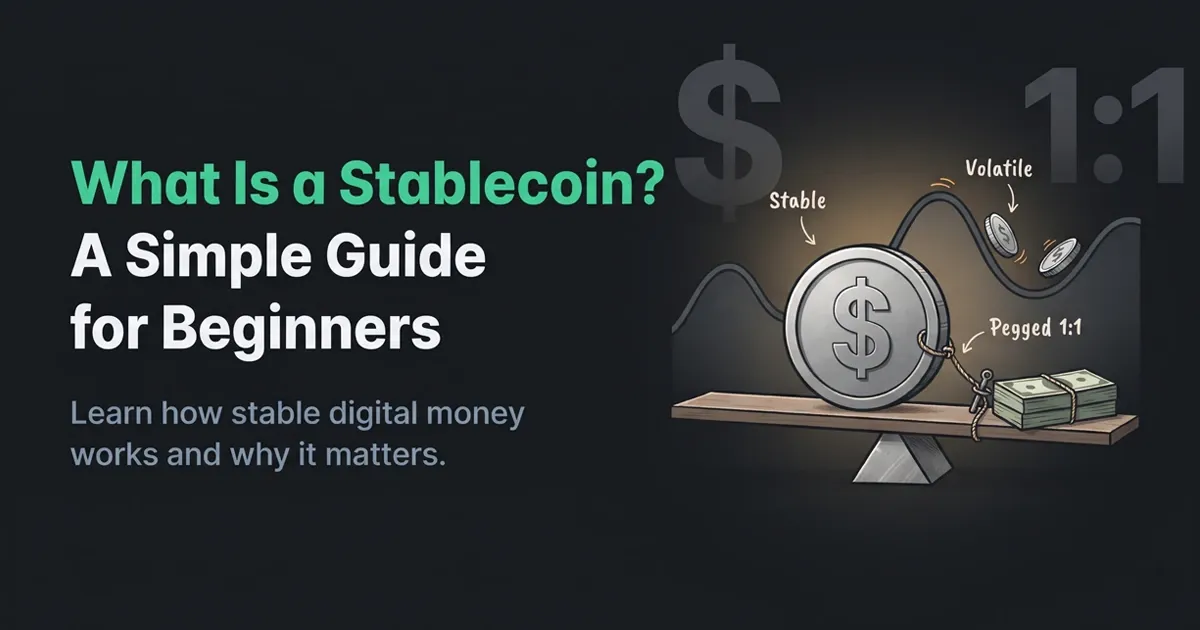
What is a stablecoin?
A stablecoin is a cryptocurrency designed to keep a steady value, usually $1, by tying its price to an asset such as the US dollar. The company that issues it holds cash and short-term government bonds in reserve, so each coin can be swapped back for about one dollar. USDT and USDC are the best-known examples.
That is the short answer. Stablecoins have moved from crypto trading desks into everyday payments. Stablecoin payment volume reached about $482 billion in the first nine months of 2026, up 45% on the same period of 2025, according to blockchain data firm Allium. Visa, Mastercard and Stripe all announced new stablecoin features in October 2026.
This guide explains the stablecoin meaning in plain English, how stablecoins work behind the scenes, the main types, USDT vs USDC, and the risks worth knowing. At the end, you can try sending one yourself on the TAAQO network for a fraction of a cent. If blockchains are new to you, read our beginner's guide to blockchain first. It takes about ten minutes.
Stablecoin meaning in plain English
Think of a stablecoin as a dollar that lives on a blockchain. A normal dollar sits in a bank account and moves through banks. A stablecoin dollar sits in a crypto wallet and moves across a blockchain network, any day of the week, in seconds.
Bitcoin and Ether are useful, but their prices can move 5% in an afternoon. That makes them awkward for paying rent or a supplier. A stablecoin solves that one problem. The amount you send is the amount that arrives, in value as well as in number.
A few words you will see again and again:
| Term | What it means |
|---|---|
| Peg | The price a stablecoin aims to hold, such as $1 or one gram of gold. |
| Issuer | The company or protocol that creates the coin, such as Tether or Circle. |
| Reserves | The cash, bonds or other assets held to back every coin in circulation. |
| Mint | Creating new coins when someone deposits money with the issuer. |
| Redeem / burn | Handing coins back for dollars, after which the issuer destroys them. |
| Depeg | When the market price drifts away from the peg, for example to $0.97. |
| Network | The blockchain a coin travels on, such as Ethereum, Tron, BNB Smart Chain or TAAQO. |
Why do stablecoins exist?
Stablecoins exist because people wanted the speed of crypto without the price swings. They fill a gap between the banking system and blockchains.
- Speed. A bank wire abroad can take one to five working days. A stablecoin transfer usually settles in seconds to minutes.
- Cost. On a low-fee network, sending $1,000 can cost less than a cent. Cross-border bank transfers often cost several percent once fees and exchange spreads are added.
- Access. Anyone with a phone and a wallet can hold dollars, which matters in countries with high inflation or limited banking.
- Always open. Blockchains do not close on weekends or bank holidays.
- Programmable. Apps and smart contracts can send, hold and split stablecoins automatically, which is useful for payroll, escrow and online checkout.
How do stablecoins work?
Here is how stablecoins work in practice. Most of the stablecoin supply works the same way. Here is the life of a typical dollar-backed coin, step by step.
- Deposit. A business or exchange sends $1 million to the issuer's bank account.
- Mint. The issuer creates 1 million tokens on a blockchain and sends them to that customer.
- Hold the reserve. The issuer keeps the $1 million in cash and short-term US Treasury bills, and publishes reports on what it holds.
- Circulate. The tokens move freely between wallets, exchanges and apps. Every transfer is recorded on the blockchain.
- Redeem. When someone returns tokens to the issuer, the issuer pays out dollars and burns those tokens, so supply and reserves stay matched.
What keeps the price at $1?
Arbitrage does most of the work. If a stablecoin trades at $0.99 on an exchange, traders buy it cheaply and redeem it with the issuer for $1, pocketing the difference. That buying pushes the price back up. If it trades at $1.01, approved traders mint new coins for $1 and sell them, which pushes the price down. As long as people trust that the reserves are real and redemption works, the price stays close to $1.
This is also why reserves matter so much. A peg is only as strong as the belief that you could swap your coin for a real dollar if you wanted to.
What are the main types of stablecoins?
Not every stablecoin is backed the same way. There are four main types, and the backing decides most of the risk.
| Type | How it is backed | Examples | Main risk |
|---|---|---|---|
| Fiat-backed | Cash and short-term government bonds held by a company | USDT, USDC, PYUSD, RLUSD | Trust in the issuer and its reserves |
| Crypto-backed | More crypto than the coin's value, locked in smart contracts | DAI, USDS | A sharp crypto crash or a smart contract bug |
| Commodity-backed | Physical assets such as gold in a vault | XAUT, PAXG | Price follows gold, not the dollar |
| Algorithmic or synthetic | Code, trading strategies or a sister token instead of full reserves | USDe; TerraUSD (failed) | The design can break under stress |
Fiat-backed coins make up the large majority of the market. Algorithmic designs carry the most risk. TerraUSD, an algorithmic stablecoin, lost its peg in May 2022 and wiped out roughly $40 billion in value within days. If you are new, stick to large, fully reserved coins.
Stablecoin examples you will meet most
There are hundreds of stablecoins, but a handful hold almost all the value. Total stablecoin supply passed $300 billion in 2026, according to DefiLlama data.
| Stablecoin | Issuer | Type | Worth knowing |
|---|---|---|---|
| USDT | Tether | Fiat-backed | The largest, at roughly 59% of supply in mid-2026. Widely used on exchanges and for transfers. |
| USDC | Circle | Fiat-backed | Second largest, at roughly 24%. Monthly reserve reports and EU MiCA authorisation. |
| DAI / USDS | Sky (formerly MakerDAO) | Crypto-backed | Decentralised. Popular in DeFi apps. |
| PYUSD | PayPal (issued by Paxos) | Fiat-backed | Built into PayPal and Venmo in the US. |
| USDe | Ethena | Synthetic | Uses a trading strategy rather than cash reserves. Higher risk. |
| RLUSD | Ripple | Fiat-backed | Newer, aimed at banks and payment companies. |
| XAUT | Tether | Gold-backed | Each token tracks one troy ounce of gold. |
USDT vs USDC: what is the difference?
USDT and USDC are the two names most beginners meet first. Both aim to stay at $1 and both are backed mainly by cash and US Treasury bills. The differences are in size, reporting and where each is accepted.
| USDT (Tether) | USDC (Circle) | |
|---|---|---|
| Launched | 2014 | 2018 |
| Share of supply (mid-2026) | About 59% | About 24% |
| Reserve reporting | Quarterly attestations | Monthly attestations |
| EU status | Not MiCA-authorised, so restricted on many EU platforms | MiCA-authorised |
| Where it is strongest | Exchanges, Asia, Africa, Latin America, the Middle East and peer-to-peer transfers | US businesses, regulated fintech and DeFi |
| Common networks | Tron, Ethereum, BNB Smart Chain and others | Ethereum, Solana, Base and others |
Which should you use? For sending money to friends, family or businesses in India, the UAE and much of the world, USDT is usually easier because more people and exchanges accept it. For a business that needs strict reporting or serves EU customers, USDC often fits better. Neither is "better" for everyone. Many people hold both and use whichever the other side accepts.
One more thing matters as much as the coin: the network. The same USDT can cost a few cents to send on one blockchain and a dollar or more on another. TAAQO supports USDT through its USDT bridge, where a standard transfer costs 0.00000002 TAAQO in network fees.
What are stablecoins used for?
- Cross-border transfers. Freelancers and families use stablecoins to move money abroad in minutes instead of days, often for much lower fees.
- Business payments and payroll. Companies pay remote teams and settle invoices in stablecoins, with a public record of every payment.
- Online checkout. Shops accept stablecoins without card chargebacks. TAAQO's business tools are built for this.
- Saving in dollars. In countries with high inflation, holding a dollar stablecoin protects savings from a falling local currency.
- Trading. Traders park money in stablecoins between trades instead of cashing out to a bank.
- DeFi and apps. Lending, borrowing and payment apps use stablecoins as their base unit.
Are stablecoins safe? The risks to know
Stablecoins are lower risk than most crypto, but they are not a bank deposit. In most countries, no government insurance scheme covers them. Here is what can go wrong.
- Depegging. USDC briefly fell to about $0.88 in March 2023 when part of its reserves sat in the failed Silicon Valley Bank. It recovered within days, but it shows a $1 coin can wobble.
- Issuer risk. You rely on the issuer to hold the reserves it claims and to honour redemptions.
- Freezing. Centrally issued coins such as USDT and USDC can be frozen by the issuer, usually at the request of law enforcement.
- Wrong network. Sending USDT on one network to an address expecting another can lose the funds. Always match the network on both sides.
- Scams. Fake tokens, fake support agents and "guaranteed yield" schemes target stablecoin holders. Nobody legitimate will ask for your seed phrase.
- Rules and tax. Regulations and tax treatment change. In India, for example, gains on crypto assets are taxed and transfers can attract TDS.
Are stablecoins regulated?
Increasingly, yes. In the United States, the GENIUS Act became law in July 2025. It sets rules for payment stablecoin issuers, including full reserves held in cash and short-term Treasuries, regular public reports and oversight by banking regulators.
In the European Union, the Markets in Crypto-Assets regulation, known as MiCA, requires stablecoin issuers to be authorised. That is why some EU platforms have limited USDT. The UAE licenses stablecoin activity through its own regulators. India has no stablecoin-specific law yet, but crypto is taxed. Check current rules where you live before you buy or hold a large amount.
How to use a stablecoin: try it on TAAQO in about five minutes
Reading about stablecoins only goes so far. The quickest way to understand one is to send a small amount and watch it arrive. Here is how to do it on TAAQO, a fast, low-fee, EVM-compatible blockchain built for payments.
- Set up a wallet. Use the TAAQO online wallet or connect MetaMask.
- Add the TAAQO network. Copy the RPC URL and chain ID 5566 from the network settings page.
- Get a little TAAQO for fees. Fees are tiny, so a very small amount lasts a long time. To practise first, grab free test tokens from the faucet.
- Bridge your USDT. Move USDT from BNB Smart Chain to TAAQO with the USDT bridge.
- Import the token. Add USDT to your wallet view on the import tokens page so you can see your balance.
- Send and check. Send a small payment, then look it up on TAAQO Scan. It should confirm in about 5 to 7 seconds.
That is the whole idea of a stablecoin in practice: dollar value, sent in seconds, with a public record you can check yourself.
What mistakes do beginners make with stablecoins?
- Sending on the wrong network, for example TRC20 to a BEP20 address.
- Buying a little-known coin because it promises high yield.
- Forgetting to keep a small amount of the network's own token to pay fees.
- Clicking links in messages instead of typing the official website address.
- Sharing a seed phrase with "support". Real support never asks for it.
- Moving a large amount before testing with a small one.
Frequently asked questions about stablecoins
What is a stablecoin?
A stablecoin is a cryptocurrency built to hold a steady price, usually $1. The issuer backs each token with reserves such as cash and short-term US Treasury bills, so you can redeem one coin for about one dollar. USDT and USDC are the best-known examples.
What is the meaning of stablecoin in simple words?
Stablecoin means a coin whose value stays stable. In simple words, it is a digital dollar that lives on a blockchain. You can send it anywhere in the world in seconds, and it keeps the same value while it travels, unlike Bitcoin or Ether.
How do stablecoins work?
An issuer receives dollars, creates the same number of tokens on a blockchain and holds the dollars in reserve. People send the tokens like any crypto. When someone returns tokens, the issuer pays out dollars and destroys the tokens. Traders buying and selling around $1 keep the price close to the peg.
What is the difference between USDT and USDC?
Both are dollar-backed stablecoins worth about $1. USDT, issued by Tether, is the largest and most used on exchanges and in emerging markets. USDC, issued by Circle, is smaller but publishes monthly reserve reports and is authorised under the EU's MiCA rules. Many people use both.
What are some examples of stablecoins?
Common stablecoin examples include USDT (Tether), USDC (Circle), DAI and USDS (Sky, formerly MakerDAO), PYUSD (PayPal), USDe (Ethena), RLUSD (Ripple) and gold-backed tokens such as XAUT. USDT and USDC together make up more than 80% of all stablecoin supply.
Can a stablecoin lose its value?
Yes, for a while. A stablecoin can slip below $1, called a depeg, if people doubt its reserves or its design fails. USDC briefly fell to about $0.88 in March 2023 before recovering, and the algorithmic coin TerraUSD collapsed in 2022. Fully reserved coins have the best record.
Are stablecoins legal?
In most countries, yes, though the rules differ. The US passed the GENIUS Act in 2025, the EU regulates stablecoins under MiCA, and the UAE has its own licensing. Some countries restrict them. Check the rules where you live, including how crypto is taxed, before you buy.
How do I get stablecoins?
Buy them on a crypto exchange with your local currency, receive them from someone else, or swap another coin for them in a wallet. Then withdraw to your own wallet on a network you choose. Start with a small amount and check the network before every transfer.
Is a stablecoin the same as a CBDC?
No. A stablecoin is issued by a private company and backed by reserves it holds. A CBDC, or central bank digital currency, is issued by a country's central bank and is a direct claim on that bank, like India's e-rupee. They can look similar in a wallet but work differently.
Final thoughts
So, what is a stablecoin? It is a digital dollar that moves at internet speed. Most stablecoins are backed by real reserves, kept close to $1 by redemption and arbitrage, and used for payments, transfers, payroll and savings. USDT is the most widely used and USDC the most heavily reported, and the network you send on matters as much as the coin.
Start small, stick to large, well-reserved coins, match the network every time and never share your seed phrase. When you are ready, bridge a little USDT to TAAQO and send your first payment. This article is for information only and is not financial advice. Crypto involves risk, so do your own research.